







Smart home ideas are no longer limited to expensive gadgets or futuristic houses. Today, homeowners and renters can use affordable technology to make everyday life more convenient, energy-efficient, secure, and comfortable. From smart lighting and automated thermostats to connected security cameras and voice-controlled appliances, there are plenty of practical ways to bring technology into your living space.
The best part is that you do not need to transform your entire house at once. A few carefully chosen devices can make a noticeable difference. Whether you are designing a new home, upgrading an existing space, or simply looking for clever ways to simplify your routine, the right connected-home solutions can help you create a home that works around your lifestyle.
What Makes a Home Smart?
A smart home is essentially a living space where connected devices can communicate with each other and be controlled automatically or remotely. Depending on the setup, you may be able to control lights, locks, heating, entertainment systems, appliances, and security devices from a smartphone, tablet, voice assistant, or central smart-home platform.
The real value comes from automation rather than simply owning lots of gadgets. For example, instead of manually turning off every light before bed, you could create a nighttime routine that switches off selected lights, locks the doors, adjusts the thermostat, and activates security devices with one command.
“The smartest home is not the one with the most gadgets; it is the one that makes everyday life easier.”
Good planning also matters. Devices should solve real problems instead of adding unnecessary complexity. Before buying anything, think about your daily routines, household needs, budget, privacy preferences, and which areas of your home would benefit most from automation.
Smart Lighting Ideas for a Modern Home
Smart lighting is one of the easiest places to begin because it can immediately change how a room feels and functions. Connected bulbs, switches, dimmers, and motion sensors can allow you to adjust brightness, schedule lighting, or control several lights together. You can create brighter settings for working and softer illumination for relaxing in the evening.
Another useful approach is to create lighting scenes. A “movie night” setting might dim the living-room lights, while a “morning” routine could gradually brighten bedroom lights. Motion-activated lighting can also be useful in hallways, bathrooms, staircases, and entryways, especially at night.
Smart lighting can contribute to energy savings as well. Scheduling lights to turn off automatically or using occupancy sensors can reduce the chance of lights being left on unnecessarily. For renters, smart bulbs are particularly convenient because they usually require little or no permanent modification to the property.
Smart Thermostats and Climate Control
Heating and cooling can account for a significant portion of household energy use, which makes climate automation an attractive upgrade. A smart thermostat can learn schedules, respond to temperature changes, and allow homeowners to adjust settings remotely through an app.
Instead of keeping the same temperature throughout the day, you can create schedules based on when people are actually home. For instance, the system can reduce heating or cooling while everyone is away and return to a comfortable setting before the household comes back.
Some advanced systems can also work with room sensors to improve temperature management in different areas. This can be especially useful in larger homes where certain rooms become warmer or cooler than others.
Smart Home Security Ideas
Security is another area where connected technology can provide practical benefits. Smart doorbells, cameras, motion sensors, window sensors, smart locks, and alarm systems can help homeowners monitor important areas and receive notifications when something unexpected happens.
A video doorbell, for example, can allow you to see who is at the entrance even when you are away. Smart locks can provide keyless access and temporary entry codes for family members, guests, or service providers. These features can make everyday access more convenient while adding another layer of security.
However, security technology should be installed thoughtfully. Strong passwords, two-factor authentication, regular software updates, and secure Wi-Fi are important parts of a connected security system. Technology can support your security strategy, but it should not replace sensible physical security practices.
Smart Kitchen Ideas
The kitchen is full of opportunities for useful automation. Connected appliances can provide reminders, monitor certain functions, and sometimes be controlled remotely. Smart ovens, refrigerators, coffee makers, dishwashers, and other appliances can add convenience when they genuinely fit your routine.
For example, a connected coffee maker could be scheduled to prepare coffee in the morning, while a smart oven may allow you to monitor cooking remotely. Some refrigerators can help track food storage, while smart plugs can add basic automation to compatible countertop appliances.
The key is to focus on functionality. Not every kitchen appliance needs an internet connection. A connected feature is worthwhile when it saves time, improves control, or solves a specific problem rather than simply adding another app to your phone.
Smart Entertainment and Living Rooms
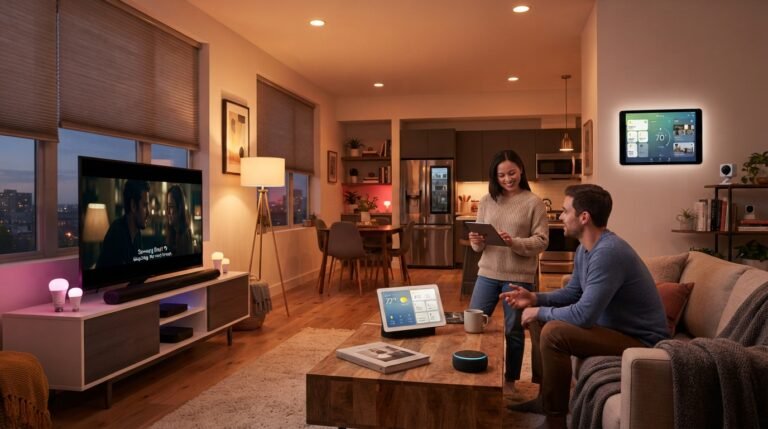
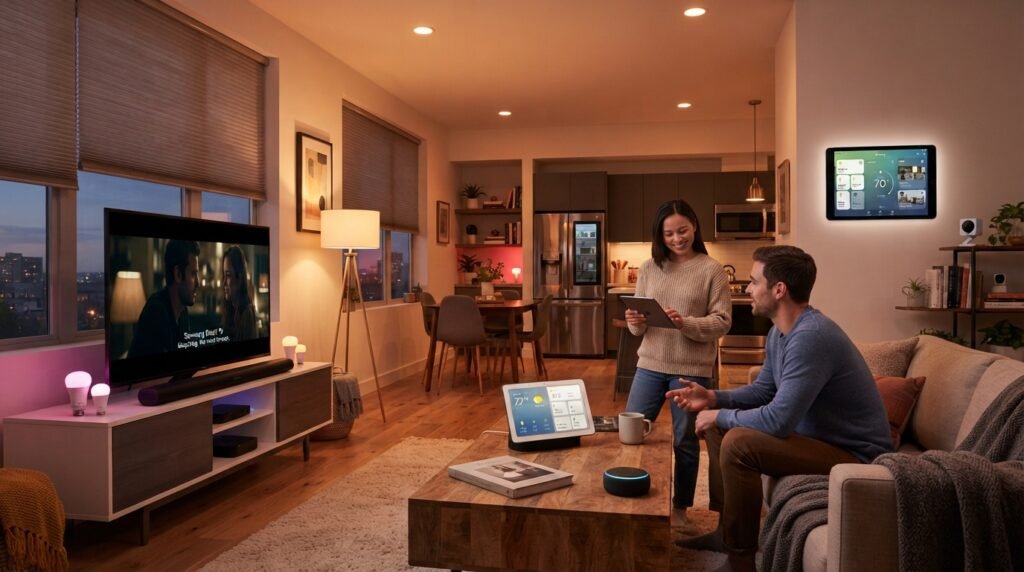
Entertainment systems are another natural fit for connected-home technology. Smart televisions, streaming devices, speakers, soundbars, and lighting can be combined into a convenient entertainment setup.
Imagine saying a single voice command that turns on the television, adjusts the lights, and starts your preferred entertainment system. You can also create different scenes for watching movies, listening to music, gaming, or relaxing.
Multi-room audio can make the experience even more flexible. Compatible speakers can allow music or podcasts to follow you from one room to another. For people who regularly entertain guests, this can create a seamless atmosphere without requiring complicated controls.
Smart Bedroom Ideas for Better Routines
Bedrooms can benefit from technology without becoming overloaded with screens and gadgets. Automated lighting, smart blinds, temperature controls, and simple routines can help create a more comfortable environment.
For example, a bedtime routine could gradually dim the lights, close compatible blinds, adjust the temperature, and turn off selected devices. A morning routine could reverse some of those actions to make waking up more convenient.
Smart blinds and curtains can also help manage natural light. Scheduling them to open in the morning and close during the hottest part of the day may improve comfort and potentially reduce unnecessary heating from direct sunlight.
Smart Bathroom Upgrades
Bathrooms may not be the first room people associate with connected technology, but there are several practical possibilities. Smart lighting, ventilation controls, water-leak sensors, and connected mirrors can add convenience without requiring a complete renovation.
Motion sensors can automatically activate soft lighting during nighttime trips to the bathroom. Leak detectors can also provide early warnings about unexpected water around sinks, toilets, washing machines, or other plumbing areas.
Water management is another area worth considering. Smart monitoring devices can help identify unusual water usage or potential leaks. Catching a small issue early may prevent a much more expensive problem later.
Smart Home Ideas for Energy Efficiency
Energy efficiency should be a major consideration when planning connected technology. Automation can help reduce wasted electricity by controlling lighting, heating, cooling, and selected appliances according to actual usage patterns.
Smart plugs are a simple starting point. They can allow users to schedule compatible devices and monitor energy consumption where supported. This can make it easier to identify appliances that consume more power than expected.
Solar systems, battery storage, energy monitors, and smart electrical management can take the concept further. However, these solutions require more planning and may involve professional installation. The right approach depends on your property, local electricity system, budget, and long-term goals.
| Smart Upgrade | Main Benefit | Ideal Location | Difficulty |
|---|---|---|---|
| Smart bulbs | Flexible lighting control | Bedrooms and living rooms | Easy |
| Smart thermostat | Climate automation | Main living area | Easy to moderate |
| Smart plugs | Device scheduling | Kitchen and bedrooms | Easy |
| Smart doorbell | Entry monitoring | Front door | Easy to moderate |
| Smart sensors | Alerts and automation | Doors, windows, rooms | Easy |
| Smart blinds | Light and privacy control | Bedrooms and living rooms | Moderate |
| Smart security system | Home monitoring | Whole home | Moderate |
| Energy monitor | Usage awareness | Electrical system | Moderate |
Smart Home Automation and Daily Routines
Automation is what can turn individual devices into a genuinely useful connected environment. Rather than controlling every product separately, you can create routines that trigger several actions together.
A morning routine might gradually increase bedroom lighting, adjust the thermostat, open smart blinds, and provide information through a compatible voice assistant. An “away” routine could switch off selected lights, adjust climate settings, lock compatible doors, and activate security features.
The goal should always be simplicity. If an automation saves time without requiring constant maintenance, it is probably useful. If it creates frequent notifications, confusing settings, or unreliable actions, simplify it.
Voice Control and Smart Assistants
Voice control can make connected devices easier to use, particularly when your hands are busy. You might use voice commands to turn lights on, adjust compatible thermostats, start entertainment, or check certain connected devices.
Voice assistants can also serve as a central interface for compatible products. However, compatibility is important. Before buying multiple devices, check whether they work with the same ecosystem or communication standards.
Privacy should also be considered. Connected microphones and cloud-based services can collect information depending on how they are configured. Review privacy settings, understand what data a device collects, and disable features you do not need.
Smart Home Ideas for Small Spaces
You do not need a large property to benefit from connected technology. Apartments, studios, and smaller homes can often benefit from compact devices that perform multiple functions.
Smart bulbs, plugs, sensors, speakers, and compact security devices are particularly useful where space is limited. Automated lighting can make a small room feel more adaptable, while smart plugs can add scheduling capabilities without replacing existing appliances.
For smaller homes, avoid buying devices simply because they are available. Choose products that solve specific problems and minimize clutter. A few well-integrated devices can be much more useful than a collection of unrelated gadgets.
Smart Home Technology for Families
Families can use connected technology to make routines easier to manage. Shared lighting controls, smart locks, schedules, security alerts, and entertainment systems can help coordinate different household activities.
Parents may appreciate automated routines that turn off selected entertainment devices at certain times or adjust lighting schedules. Smart locks can also provide convenient access for family members without requiring everyone to carry physical keys.
At the same time, families should establish clear rules around connected devices. Children should understand which devices are private, how voice assistants should be used, and why strong passwords and security settings matter.
How to Choose the Right Smart Devices
The best technology depends on your lifestyle rather than the size of your device collection. Start by identifying everyday frustrations. Do you frequently forget to turn lights off? Would automatic climate control help? Do you want better visibility around your front door? Are energy bills a concern?
Once you identify the problem, choose technology that addresses it directly. Check compatibility, installation requirements, ongoing costs, privacy policies, and security features before purchasing.
It is also smart to think about future expansion. Choosing products that can work within a compatible ecosystem can make it easier to add new devices later without rebuilding your entire setup.
Common Mistakes to Avoid
One common mistake is buying too many devices at once. A large collection of products from different manufacturers can create compatibility problems and make automation unnecessarily complicated.
Another mistake is ignoring network reliability. Connected devices depend heavily on your home network, so a weak or unstable connection can affect performance. A reliable router and sensible device placement can make a major difference.
Security should never be treated as an afterthought. Change default passwords, enable available security features, keep firmware updated, and carefully consider which devices need remote access.
How to Build a Smart Home on a Budget
You do not need a large budget to begin. Start with inexpensive upgrades such as smart bulbs, plugs, or basic sensors. These devices can introduce automation without requiring major electrical or structural changes.
After learning how the system works, you can gradually add more advanced equipment. A staged approach allows you to determine which features are genuinely useful before spending more money.
A simple budget strategy is to prioritize comfort, security, and energy savings. Devices that solve recurring problems are usually more valuable than novelty products that rarely get used.
The Future of Connected Homes
Smart-home technology is becoming increasingly focused on interoperability, automation, energy management, and personalized experiences. Instead of requiring users to control every device manually, future systems are likely to become better at responding to routines and environmental conditions.
Artificial intelligence may also play a growing role in home automation. Systems could potentially learn household patterns and suggest useful changes, such as adjusting climate settings or identifying unusual energy consumption.
Even as technology evolves, the fundamental principle remains the same: connected devices should make life easier. A successful setup is not necessarily the most advanced one. It is the one that works reliably and fits naturally into everyday life.
Final Thoughts on Smart Home Ideas
The best smart home ideas are practical, flexible, and tailored to the people living in the house. You can begin with a single smart bulb or sensor and gradually build a connected environment around your needs. There is no requirement to automate everything.
Think about what would save you time, improve comfort, strengthen security, or reduce wasted energy. Then choose reliable technology that works well together. With thoughtful planning, even a modest collection of connected devices can transform everyday routines into something more convenient and efficient.
Frequently Asked Questions
What are the best smart home ideas for beginners?
Some of the easiest options include smart bulbs, smart plugs, motion sensors, and a compatible smart speaker. These devices generally require less installation and can introduce useful automation without making the home complicated.
The best starting point depends on your needs. If convenience is your priority, begin with lighting or plugs. If security matters most, consider entry sensors or a connected doorbell.
Are smart home devices worth the money?
Smart home devices can be worthwhile when they solve a genuine problem. Automated lighting, climate control, security alerts, and energy monitoring can provide convenience and potentially reduce waste.
However, not every connected product offers enough value to justify its cost. Consider how frequently you will use a feature and whether the device is reliable before purchasing it.
Can I create a smart home without replacing my existing appliances?
Yes. Many smart home ideas work with existing equipment. Smart plugs, bulbs, switches, sensors, and compatible controllers can add connected functionality without replacing everything.
For appliances that are not inherently smart, compatibility should be checked carefully. A smart plug, for example, is useful only when the appliance safely supports the type of automated power control being used.
Are smart homes difficult to set up?
Basic systems can be quite easy to install. Smart bulbs, plugs, and some sensors can often be configured through a mobile application in a relatively short time.
More advanced installations, such as hardwired switches, thermostats, security systems, or electrical equipment, may require additional technical knowledge or professional installation. Planning the system before purchasing devices can make the setup much easier.
How can smart home ideas help save energy?
Automation can reduce unnecessary energy use by switching devices off when they are not needed and adjusting heating, cooling, and lighting according to schedules or occupancy.
Energy savings vary depending on the equipment and household habits. The biggest benefit often comes from combining efficient devices with sensible automation rather than relying on technology alone.
Is smart home technology secure?
Connected technology can be secure when properly configured, but no internet-connected system should be treated as completely risk-free. Use strong, unique passwords and enable two-factor authentication when available.
Keep devices updated and secure your home network. It is also worth reviewing privacy settings so you understand what information your connected devices collect and how that information is handled.
What is the easiest room to make smart?
The living room or bedroom is often a good starting point because smart lighting, speakers, plugs, and entertainment devices can be added without major renovation.
The right room ultimately depends on your routine. Choose the area where automation can solve the most noticeable everyday problem, then expand gradually.