







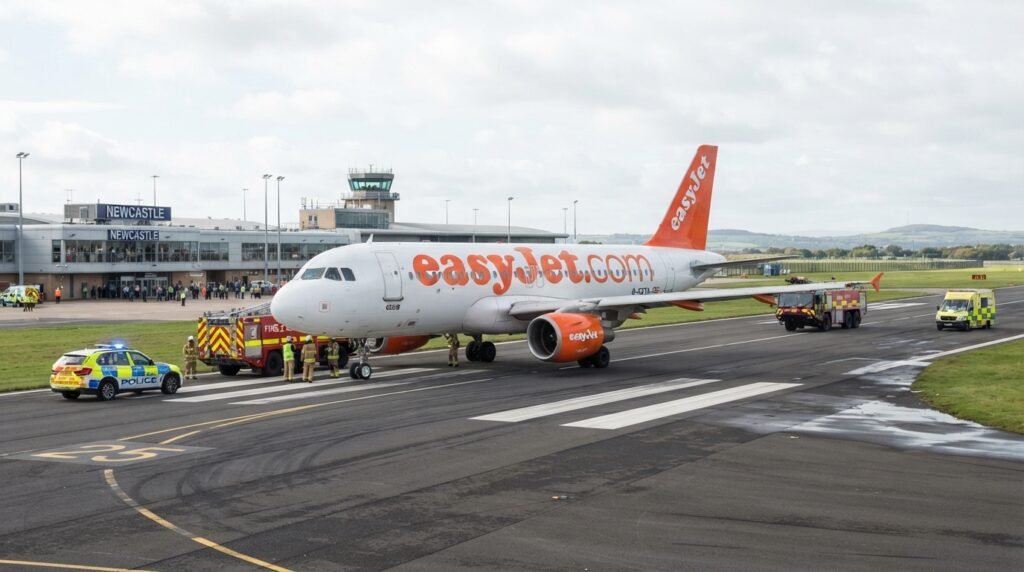


The phrase “easyJet flight U2238 emergency landing Newcastle” has attracted considerable attention online, but there is an important detail that should be clarified before discussing the incident. The flight involved in the Newcastle diversion on 27 October 2025 was identified as U22238 / EZY2238, an easyJet service travelling from Copenhagen to Manchester. The shorter flight number U2238 is associated with a different easyJet service operating between Newcastle and Bristol.
According to contemporary reporting, the Copenhagen-to-Manchester aircraft diverted to Newcastle after a passenger required urgent medical attention. EasyJet confirmed that the passenger was met by medical services after the aircraft landed, and the flight subsequently continued to Manchester.
This distinction matters because many online articles have repeated the shorter flight number. Rather than simply repeating the error, this article explains the incident clearly, looks at why Newcastle was selected, explains the meaning of the emergency code, and separates confirmed information from speculation.
The Flight Number Confusion Explained
One of the most interesting parts of this story is the similarity between U2238 and U22238. At first glance, the numbers look almost identical, so it is easy for a headline, social media post, or search query to lose one digit. However, the difference changes the identity of the flight.
Current flight-tracking records show that U2238 / U2 238 is an easyJet service operating from Newcastle International Airport to Bristol Airport. Recent records show the flight operating normally on that route.
The aircraft that diverted on 27 October 2025 was instead associated with U2 2238, commonly written as U22238, and with the operational identifier EZY2238. It was travelling from Copenhagen to Manchester when the crew diverted to Newcastle because a passenger needed urgent medical assistance.
| Detail | Correct information |
|---|---|
| Airline | easyJet |
| Flight involved in the diversion | U22238 / EZY2238 |
| Common search phrase | easyJet flight U2238 emergency landing Newcastle |
| Date | 27 October 2025 |
| Original route | Copenhagen → Manchester |
| Diversion airport | Newcastle International Airport |
| Aircraft | Airbus A320 |
| Reported reason | Passenger requiring urgent medical attention |
| Emergency code | 7700 |
| Final outcome | Safe landing and onward journey to Manchester |
Understanding this distinction makes the rest of the story much easier to follow.
What Happened During the EasyJet Flight?
The aircraft departed Copenhagen on the evening of 27 October 2025, heading for Manchester. It was a normal international short-haul journey until a passenger onboard developed a situation that required urgent medical attention.
EasyJet later confirmed that the aircraft was diverted because a customer onboard required urgent medical assistance. Emergency services met the aircraft after it reached Newcastle, allowing the passenger to receive care without waiting for the aircraft to reach Manchester.
This is why the event should be understood primarily as a medical diversion, rather than as evidence of an aircraft accident. A diversion can be an important safety decision even when the aircraft itself remains fully capable of flying.
The crew had to consider the condition of the passenger, the remaining flight time, suitable airports, emergency medical availability, weather, runway facilities, and air traffic conditions. Diverting to a major airport with appropriate emergency services can be the safest option in such circumstances.
Why Was Newcastle Chosen as the Diversion Airport?
Newcastle International Airport is a significant airport in northeast England and was a practical diversion point for an aircraft travelling toward northern England. Its location made it possible for the flight crew to reach suitable airport facilities while also allowing medical responders to meet the aircraft.
Choosing a diversion airport is not simply about finding the closest runway on a map. Pilots and air traffic controllers consider several operational factors. The airport must be suitable for the aircraft, accessible within the available time, and capable of handling the particular emergency.
In a passenger medical emergency, access to medical assistance can be particularly important. The objective is to get the affected passenger onto the ground where trained professionals can provide treatment as quickly as practical.
The decision to divert therefore does not necessarily indicate that the aircraft itself was unsafe to fly. Instead, it can demonstrate that the crew is responding appropriately to an urgent situation onboard.
What Does Emergency Code 7700 Mean?
Flight-tracking enthusiasts may have noticed references to Squawk 7700 when discussing the incident. In aviation, 7700 is a general emergency transponder code that alerts air traffic control that an aircraft is experiencing an emergency.
It is important not to interpret the code too narrowly. A 7700 squawk does not automatically mean an engine has failed, the aircraft is falling, or the plane is about to crash. It is a broad emergency indication that can be used for different urgent circumstances.
In this case, public reporting connected the emergency with a passenger welfare issue. Aviation reporting also recorded the aircraft using 7700 before diverting toward Newcastle.
“The safety and wellbeing of our customers and crew is always easyJet’s highest priority.” — easyJet statement reported after the diversion.
That context is important when reading flight-tracking screenshots. A dramatic-looking flight path or emergency code can appear alarming without explaining what actually happened inside the aircraft.
Was There an Aircraft Mechanical Failure?
There is no reliable public evidence establishing that an engine failure, fire, structural problem, or other major mechanical malfunction caused the Newcastle diversion.
The information released after the event pointed instead to a passenger requiring urgent medical attention. EasyJet’s statement, reported by the Manchester Evening News and Yahoo News UK, specifically described the reason for the diversion as a customer onboard requiring urgent medical attention.
That distinction is particularly important because the phrase “emergency landing” can create the impression that the aircraft itself suffered a serious technical failure. In everyday language, an emergency landing sounds much more dramatic than an operational diversion caused by a passenger medical situation.
From an aviation perspective, however, both situations require careful decision-making. The crew must assess the circumstances, communicate with air traffic control, manage the cabin, and select the safest available course of action.
The available evidence therefore supports describing this event as an emergency diversion caused by a passenger welfare issue, rather than a confirmed aircraft malfunction.
What Happened After the Aircraft Reached Newcastle?
The aircraft landed safely at Newcastle International Airport, where medical services were available to assist the passenger. EasyJet subsequently confirmed that the passenger was met by medical services on arrival.
The important point is that the aircraft did not remain permanently stranded at Newcastle. After the medical situation had been dealt with, the service continued toward its original destination.
This is consistent with a situation in which the aircraft itself remained operational. If a serious technical defect had made the aircraft unfit to continue, the circumstances would have been different.
For passengers onboard, however, the diversion naturally meant a delay and an unexpected change to their journey. Even when a diversion is handled safely, it can be stressful, especially when passengers do not initially know why the aircraft is changing course.
What Was the Passenger’s Condition?
Public information about the individual passenger’s medical condition is limited, and that is appropriate. A person’s medical details are private, and there is no need to speculate about a diagnosis or condition that has not been publicly confirmed.
The reliable information available is that the passenger required urgent medical attention and was met by medical services after the aircraft landed at Newcastle. EasyJet did not publicly provide unnecessary personal medical details in the statement reported by the Manchester Evening News.
This is an important lesson for readers and publishers. When reporting aviation emergencies, it is better to distinguish between confirmed facts and assumptions. A passenger welfare issue can have many possible causes, and guessing at the medical condition would add information that is not supported by the available evidence.
The safest summary is therefore simple: a passenger needed urgent medical assistance, the crew diverted to Newcastle, emergency services responded, and the flight later continued.
Did the Flight Eventually Reach Manchester?
Yes. After the diversion to Newcastle and the response to the passenger’s medical situation, the aircraft continued toward Manchester Airport, its original destination. This was confirmed by easyJet in its statement about the incident.
That outcome is significant because it helps explain the nature of the event. The aircraft’s unexpected stop at Newcastle was not the end of the journey. Instead, Newcastle served as the emergency diversion airport before the service resumed.
Passengers may understandably have wondered whether they would have to disembark permanently, find alternative transportation, or spend the night at Newcastle. However, the available reporting indicates that the aircraft continued to Manchester after the emergency response.
The incident therefore ended without a reported crash or major aircraft accident. The primary concern was the welfare of the passenger who needed urgent care.
Why the Story Became Confusing Online
The easyJet flight U2238 emergency landing Newcastle search phrase demonstrates how quickly small differences in flight numbers can create large factual errors online.
Flight-tracking websites use different aviation identifiers depending on the system. easyJet uses U2 as its IATA airline code, while EZY is the airline’s ICAO designator. As a result, a flight may appear differently in booking systems, aviation databases, airport systems, and tracking platforms.
The Copenhagen-to-Manchester service is commonly identified as U2 2238, which can appear as U22238 when written without a space. Its operational identifier is EZY2238. By contrast, U2 238, written as U2238, is a different easyJet service connecting Newcastle and Bristol. Current flight records support this distinction.
This is a useful reminder that readers should not assume two flight numbers are identical simply because they look similar. One missing or additional digit can point to a completely different aircraft and route.
EasyJet Flight U2238 Emergency Landing Newcastle: Key Facts
The easiest way to understand the story is to separate the commonly searched phrase from the technically accurate details.
The incident took place on 27 October 2025, when an easyJet service travelling from Copenhagen to Manchester diverted to Newcastle after a passenger required urgent medical attention. EasyJet confirmed that medical services met the passenger after landing and that the aircraft later continued to Manchester.
At the same time, current flight-history records show that U2238 itself is a Newcastle-to-Bristol service. This means an article using the exact search phrase should clarify the difference rather than incorrectly claim that the Newcastle-to-Bristol flight was the aircraft involved in the 2025 emergency.
| Search term | What it refers to |
|---|---|
| U2238 | Separate easyJet Newcastle–Bristol service |
| U2 238 | Same Newcastle–Bristol flight |
| U22238 | Copenhagen–Manchester service involved in the diversion |
| EZY2238 | Operational identifier for the Copenhagen–Manchester service |
| Newcastle emergency landing | The 2025 diversion involving the Copenhagen–Manchester service |
This clarification makes the article more useful for anyone who has encountered conflicting information.
What This Incident Says About Airline Safety
Unexpected medical situations are among the challenges commercial aviation crews must be prepared to manage. Cabin crew receive training for dealing with passenger health emergencies, while pilots have procedures for deciding whether to continue, divert, or land as quickly as practical.
The Newcastle diversion shows how an airline can respond when continuing to the original destination is not the best option for someone onboard. Instead of waiting until Manchester, the crew diverted to an airport where medical services could meet the aircraft.
That does not mean every medical issue requires an emergency landing. The decision depends on the seriousness of the situation and the assessment of the crew and available medical advice. However, when urgent care is needed, an unscheduled landing can be the most sensible safety decision.
For passengers, the key takeaway is reassuring: an emergency declaration is not automatically synonymous with an aircraft disaster. It can mean that the crew is taking proactive action to protect someone onboard.
What Passengers Can Learn From the Newcastle Diversion
The incident is also a useful example of why passengers should follow cabin crew instructions during an unexpected situation. Aviation crews are trained to manage emergencies while keeping passengers informed when appropriate.
Passengers may also see flight-tracking information online and become concerned when an aircraft changes direction or displays an emergency code. However, tracking data usually cannot explain the complete situation inside the cabin.
A sudden change in route can happen for many reasons, including weather, airport restrictions, medical emergencies, technical concerns, or operational requirements. The flight path alone does not tell the whole story.
In the case associated with the easyJet flight U2238 emergency landing Newcastle search, the publicly confirmed explanation was a passenger requiring urgent medical attention, not a confirmed catastrophic aircraft failure.
Why Accurate Reporting Matters
Aviation stories can spread extremely quickly because flight-tracking maps are public and unexpected diversions naturally attract attention. But a screenshot of an aircraft turning toward an airport does not provide enough information to explain why it happened.
Accurate reporting requires checking the flight number, route, date, airline statement, and other reliable evidence. This is especially important when several similar flight numbers exist.
For this incident, the distinction between U2238 and U22238 is a perfect example. Current records identify U2238 as Newcastle to Bristol, while reporting about the October 2025 emergency identifies EZY2238/U22238 as the Copenhagen-to-Manchester service that diverted to Newcastle.
Readers searching for the incident should therefore use several variations, including easyJet U22238, EZY2238 Newcastle diversion, and Copenhagen Manchester easyJet emergency, rather than relying on one shortened flight number.
Conclusion
The story behind the easyJet flight U2238 emergency landing Newcastle search is less mysterious than some online headlines suggest. The incident people are generally referring to happened on 27 October 2025, when an easyJet service travelling from Copenhagen to Manchester diverted to Newcastle because a passenger required urgent medical attention. EasyJet confirmed that medical services met the passenger after arrival and that the flight later continued to Manchester.
The biggest correction is the flight number. The diverted service was U22238 / EZY2238, while U2238 / U2 238 is a separate Newcastle-to-Bristol service that continues to appear in current flight records.
There is also no reliable evidence that an engine failure, crash, or major aircraft malfunction caused the diversion. The available reporting points to a passenger welfare or medical emergency. The safe landing at Newcastle and subsequent continuation to Manchester show that the crew used the diversion as a practical safety measure.
Ultimately, this was a reminder of how aviation safety works in real time: when a passenger needs urgent help, pilots can change the flight plan, declare an emergency, land at a suitable airport, and allow medical professionals to respond. The event may have caused concern and delays for passengers, but the available evidence indicates that it was handled safely and professionally.
Frequently Asked Questions
What happened in the easyJet flight U2238 emergency landing Newcastle incident?
The incident commonly described by the phrase easyJet flight U2238 emergency landing Newcastle actually involved easyJet flight U22238/EZY2238 on 27 October 2025. The aircraft was flying from Copenhagen to Manchester when it diverted to Newcastle because a passenger required urgent medical attention.
The aircraft landed safely, medical services met the passenger, and the flight later continued to Manchester. There was no confirmed report of a crash or major aircraft failure associated with the diversion.
Was easyJet flight U2238 actually the aircraft that diverted to Newcastle?
Not technically. This is the most important correction to the popular search phrase easyJet flight U2238 emergency landing Newcastle.
Current flight records identify U2238 / U2 238 as a separate easyJet service operating between Newcastle and Bristol. The aircraft involved in the October 2025 diversion was U22238 / EZY2238, operating from Copenhagen to Manchester.
Why did the easyJet aircraft divert to Newcastle?
The aircraft diverted because a passenger onboard required urgent medical attention. EasyJet confirmed that the passenger was met by medical services after the aircraft arrived in Newcastle.
The diversion allowed the passenger to receive medical assistance sooner rather than waiting for the aircraft to reach Manchester.
Did the easyJet flight have an engine failure?
There is no reliable public evidence that an engine failure caused the incident. Available reporting from easyJet attributed the diversion to a passenger requiring urgent medical attention.
Therefore, claims that the aircraft suffered an engine failure should not be presented as established facts unless new authoritative evidence becomes available.
What does Squawk 7700 mean in the easyJet incident?
Squawk 7700 is a general emergency transponder code used to alert air traffic control that an aircraft has an emergency situation.
It does not specifically mean engine failure or imminent crash. In this case, the emergency declaration was associated with the passenger welfare situation reported by the airline and aviation sources.
Did the aircraft land safely at Newcastle?
Yes. The aircraft reached Newcastle safely, where medical services attended to the passenger. EasyJet subsequently confirmed that the flight continued to Manchester.
The safe landing was therefore an important part of the incident’s outcome.
Did the flight eventually reach Manchester?
Yes. The Copenhagen-to-Manchester service continued to Manchester after the diversion to Newcastle and the medical response. EasyJet confirmed the onward journey in its statement.
This means the Newcastle stop was a diversion during the journey rather than a permanent cancellation of the flight.
When did the easyJet Newcastle emergency happen?
The incident occurred on 27 October 2025. Contemporary reporting published the following day described the Copenhagen-to-Manchester flight being diverted to Newcastle because a passenger required urgent medical attention.
Some newer online pages discuss the incident in 2026, but those articles are generally referring back to the original 2025 event rather than documenting a separate confirmed 2026 emergency.
Is U22238 the same as EZY2238?
Yes, the Copenhagen-to-Manchester service involved in the Newcastle diversion is identified as U2 2238/U22238 in the commercial flight-number format and EZY2238 in the ICAO-style identifier used in aviation operations and tracking. Contemporary reporting specifically referred to EZY2238.
That is why readers may encounter different-looking identifiers while researching the same flight.
What is the correct keyword to use when researching the incident?
People commonly search for easyJet flight U2238 emergency landing Newcastle, but more precise searches include easyJet U22238 Newcastle, EZY2238 emergency diversion, and easyJet Copenhagen to Manchester Newcastle diversion.
Using these variations can help separate the actual 2025 incident from the unrelated U2238 Newcastle-to-Bristol service.